Atradius Atrium
保険契約情報、与信限度額申請ツール、インサイトに直接アクセスできます。

 日本
日本
 Brazil
 Portugal
 Spain
Spain
 アイルランド
 アラブ首長国連邦
 イギリス王国
 イタリア
イタリア
 インド
インド
 オーストラリア
 オーストリア
 オランダ
オランダ
 カナダ
カナダ
 ギリシャ
ギリシャ
 グループ
グループ
 シンガポール
 スイス
スイス
 スウェーデン
 スロバキア
スロバキア
 スロベニア
スロベニア
 チェコ共和国
 デンマーク
デンマーク
 ドイツ
ドイツ
 トルコ
トルコ
 ニュージーランド
 ノルウェー
ノルウェー
 ハンガリー
ハンガリー
 フィンランド
 フランス
フランス
 ブルガリア
ブルガリア
 ベルギー
ベルギー
 ポーランド
ポーランド
 メキシコ
メキシコ
 リトアニア
リトアニア
 ルーマニア
ルーマニア
 香港SAR
香港SAR
 中国
日本
中国
日本
 米国
米国

At the beginning of this year, we anticipated global transportation and logistics output to increase by 4.3% in 2025 and by 3.7% in 2026. However, we have now revised this forecast downwards to 2.5% and 2.4% respectively, as we expect the pace of trade growth to ease significantly in the last months of 2025 and through 2026. This contrasts with the earlier months of the year where front-loading ahead of trade war restrictions directly boosted global trade growth, while AI-related investment increased the trade in goods related to data centre infrastructure and other AI equipment.
Tariffs are increasingly weighing on trade activity, and uncertainty drags on companies´ investments. This has an impact on all stages of the goods economy.
Less production and transport of raw and intermediate goods for manufacturing and less shipment of goods from factories to consumers will inevitably spill over to the freight-focused transport sector segments, like trucking and ocean freight.
In order to improve their supply chain resiliency, industries and businesses that have been focused on just-in-time production may keep greater levels of inventory as a safety buffer. As a result, we expect greater demand for warehouse storage facilities in order to store inventory, avoid delays, and reduce the impact of supply chain disruptions.
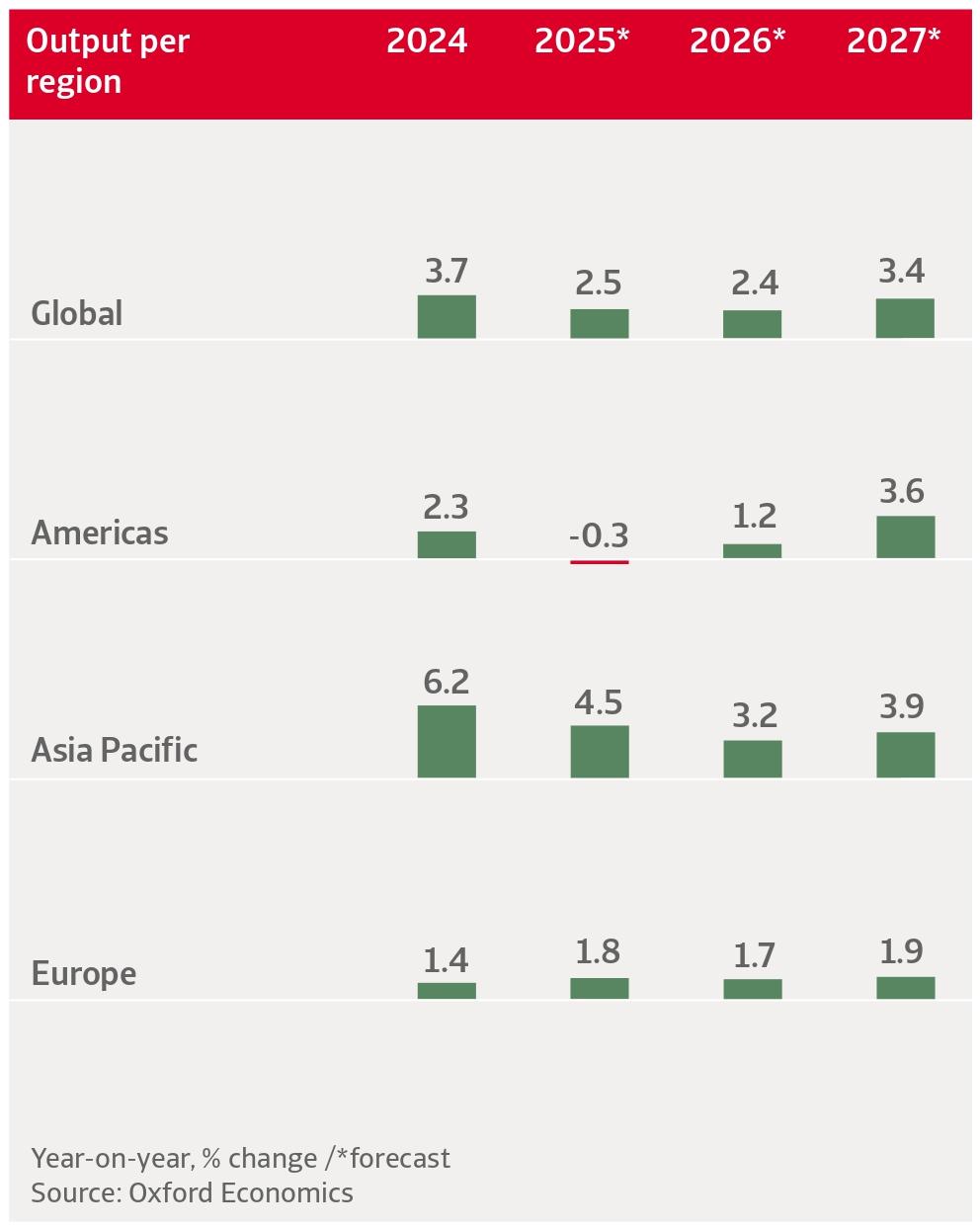
The US transportation and logistics industry is navigating a complex environment. Consumer confidence is currently declining, and the labour market appears to be cooling off. Both could affect demand for shipping of durable and non-durable consumer goods.
At the same time the sector faces significant challenges from trade distribution, labour shortages, and geopolitical instability. After growing 1.8% in 2024, we expect sector output to decrease by 0.6% in 2025, followed by a modest 1% rebound in 2026.
Tariff increases on US imports have reduced freight volumes especially on the transpacific routes from Asia to the US. The water transport segment is expected to contract by 4.7% this year and by 0.1% in 2026.
Trucks are the key transport mode for goods in the US. Land transport is expected to grow only 0.3% in 2026 after a modest 0.4% increase this year. Weaker trade activity with Canada and Mexico is impacting trucking, which plays a vital role in cross-border trade under the USMCA framework. Labour shortages are contributing to delays and rising cost, and the restrictive immigration policy could exacerbate this issue.
Air transport output is forecast to increase by 1.6% in 2026, mainly on the back of continuing growth of higher passenger volumes, while air freight is benefiting from increased demand for faster ecommerce delivery. However, there is some downside risk, as Washington´s decision to end the de minimis exception for all parcels entering the US has prompted several countries to suspend small package deliveries to the US, most of which are undertaken via air freight.
In the mid-term, government investment in infrastructure improvement should benefit the sector by promoting greater supply chain efficiency, reducing costs, and stimulating demand for transportation and logistics services.
Chinese transportation and logistics output is forecast to grow by 4.4% in 2025 and by 3.3% in 2026, largely on the back of resilience in both industrial production and exports. So far, US tariffs have not meaningfully dented the overall trade balance, as Chinese exports to Asia, Africa and Europe have increased.
While export volumes to traditional partners like Europe and the US could face headwinds, China’s ports remain among the world’s busiest and are likely to sustain high output in the coming years. This is due to increasing trade with emerging markets and ongoing innovation in port logistics.
Air cargo benefits from continued advancements in logistics, and digitalisation will enhance operational efficiency, supporting growth and resilience.
We expect the transportation and logistics sector will benefit from government support for businesses and investment in infrastructure (domestic and international) in the coming years. Those investments show China´s ambition to ensure that it remains a major hub in global supply chains and logistics.
Higher GDP per capita and rising household incomes will sustain demand for domestic transport services. Road freight volumes are expected to show annual growth rates of more than 3% in the coming five years.
Indian transportation and logistics output is forecast to grow by 6.9% in 2026 after a 10.2% increase in 2025. The government has introduced initiatives try to boost the manufacturing sector by improving the business environment and enhancing logistics infrastructure.
However, even more investment in transport infrastructure is required to overcome existing inefficiencies and bottlenecks.
We expect Japan´s transportation and logistics output to grow by 1.4% in 2025 and by 0.4% in 2026. While many of the production shutdowns related to safety test scandals in the automotive sector have largely been resolved, lower external demand due to US tariffs will affect Japan’s key industries.
Strength in semiconductor related production and exports will not be able to provide enough demand for transport services to compensate for weaknesses in other key sectors. However, demand for passenger transport remains relatively robust, supported by tourism inflow.
After a 2.4% increase this year, we expect eurozone transportation and logistics output to grow by only 0.9% in 2026. The slowdown is mainly due to the region’s protracted industrial recovery.
Industrial production and transport demand surged in H1 of 2025 due to US companies putting in orders to front-run tariffs, and it only pulled back mildly in the second quarter. However, US tariffs and increasing Chinese competition have started to weigh on industrial output, trade and investment in the eurozone, which will deprive the transport sector of a key demand pillar over the next year.
We expect that over the coming two years transport and logistics demand will be mainly driven by services and household consumption. Consumers are increasingly benefitting from lower inflation and rising wages, which increases their willingness to accelerate spending on goods and services, both of which will benefit the consumer-related segment of the transport and logistics sector.
In Germany, the largest eurozone market, we expect transport and logistics output to grow by only 0.3% in 2026. The main reason for this is the ongoing subdued industrial performance of the country. This dampens demand for services to move raw materials to factories, intermediate inputs between factories, and final products out of factories to retailers/wholesalers or out of the country for international shipping.
At the same time the German transport and logistics sector continues to struggle with staff shortages and fierce competition from Central and Eastern Europe. This mainly affects the road freight transport subsector. Due to a very competitive environment and thin margins credit risk remains high across the German transport and logistics sector.
We expect UK transport and logistics output to grow by 1.4% in 2026. However, ongoing staff shortages hamper sectoral activity and growth. In the haulage sector, rising wages, vehicle replacement expenses, and fuel prices are squeezing margins.
Sustainability efforts will remain a priority, with haulage companies transitioning to electric vehicles and warehousing businesses focusing on reducing emissions. These shifts require significant upfront investment, which will further stretch resources in the coming months. Cybersecurity remains a critical issue for haulage firms, as attacks have highlighted vulnerabilities in the sector.
Due to tight margins and fierce competition, the credit risks will remain high across the British transport sector.
Download the full report from the related documents section below for detailed insights into challenges, performance and credit risks in major transportation and logistics markets worldwide.
To explore to strengthen your own credit risk strategy, get in touch with us and see how we can help you stay ahead.
